

Funded by the HSE National HSCP Office as part of a joint CPD funding submission with Irish Association of Social Workers (IASW) and priority is for those employed in publicly funded health care settings. Before registering your interest in attending this course; please read the Terms and Conditions for attending publicly funded CPD events here
Rationale:
HSCP work-related stress can lead to several negative effects, including absenteeism, presenteeism, poor work performance, lack of staff engagement, compassion fatigue, staff burnout, mental health, and well-being issues (Bartlett et al., 2019). Post COVID, HSCPs highlight mental health and staff burnout as some of the most pressing issues, with health and social care organisations reporting high rates of HSCP turnover, which are negatively affecting the quality, consistency, and stability of services (Unison, 2022; IASW, 2023). Mindfulness based programmes (MBPs) have evidenced positive mental health and well-being outcomes for those working in health and social care (Vonderlin et al., 2020).
Overview:
The Mindfulness-based Health and Social Care (MBHSC) group programme is a unique mindfulness-based programme which focusses on improving the self-care and practice of health and social care professionals. MBHSC is a theory and evidence-informed programme which focusses on reducing stress, emotional exhaustion, depersonalisation of service users/patients, improving well-being and a range of practice skills and competencies.
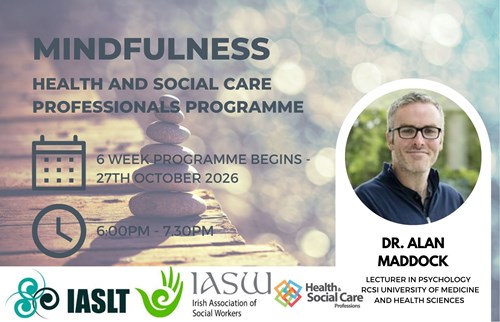
MBHSC will be delivered over a 6-week period from 27th October. Single weekly sessions will be 1.5 hours in duration from 6-7.30pm each week. Weekly sessions will be facilitated online on MS Teams by Dr. Alan Maddock. Dr. Maddock is professionally qualified social worker who specialised in mental health social work, and is currently a Lecturer in Psychology. Dr. Maddock developed the MBHSC programme, is a trained mindfulness facilitator, and has over 10 years mindfulness meditation experience.
Programme Structure:
Each session will adhere to a standardised protocol and will cover health and social care practice exercises and topics which were examined within the context of mindfulness.
The course structure will consist of:
Each session will introduce different mindfulness-based practices (e.g. mindful body scanning, mindful yoga) and psychoeducation on the potential role that mindfulness could play in our self-care, and professional practice. Participants will be provided with psychoeducation on practical ways in which to apply the experiential learning attained from these practices when confronted with stressful personal and/or practice situations. The development of mindfulness is predicated upon regular and repeated practice, thus participants will be requested to engage in daily mindfulness-based homework exercises for 20 minutes per day, for 6 out of the 7 days, between sessions. Each session will include practice role plays and discussion. This will allow participants to have an opportunity to apply their evolving experiential learning to a practice case context.
Course Dates and Times:
*You must attend all 6 dates.
Previous Evaluation:
The MBSWSC programme has been extensively evaluated. Two different randomised controlled trials with 121 social workers in Northern Ireland (Maddock et al., 2023; 20224) found that MBSWSC reduced stress, emotional exhaustion, depersonalisation of service users, symptoms of anxiety and depression, and improved well-being versus an active control group. A focus group study with 13 social workers who completed the MBSWSC programme found that MBSWSC participation social work assessments, service user engagement and team working, values oriented social work practice, and the development of key social work skills (including verbal communication, non-verbal communication, and reflection skills) (Maddock et al., 2024).
Award:
This programme was awarded a Queen’s University Belfast Digital Teaching Award in June 2021.
References: (papers available via open access at the accompanying link)
Maddock, A., McGuigan, K., & McCusker, P. (2023). A randomised trial of Mindfulness-based Social Work and Self-Care with social workers. Current Psychology, 1-14. https://link.springer.com/article/10.1007/s12144-023-04410-w
Maddock, A., McGuigan, K., & McCusker, P. (2024). Mindfulness-based social work and self-care with social work professionals: Replication and expansion of a randomised controlled trial. The British Journal of Social Work, 1-21. https://doi.org/10.1093/bjsw/bcae011
Maddock, A., McGuigan, K., & McCusker, P. (2024). Exploring Social Work professionals’ Experiences of the Mindfulness-Based Social Work and Self-Care Programme: A Focus Group Study. Social Work in Public Health, 1-16. https://www.tandfonline.com/doi/full/10.1080/19371918.2024.2325564
Visit the CPD Events FAQ page HERE

If you have are having difficulty logging in or registering, please contact us at cpdadmin@iaslt.ie.
Sign in to your account to continue.