
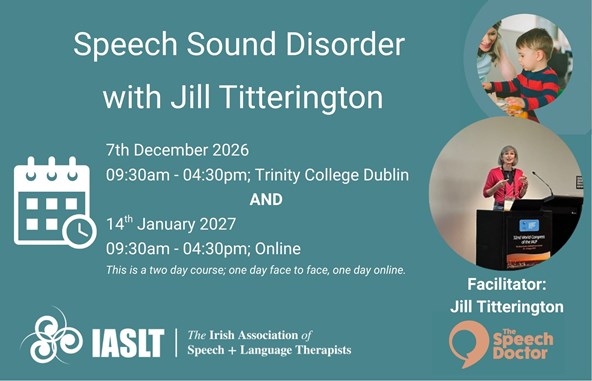
This course will focus on up-date on phonetic transcription, analysis of child speech, and the use of conventional minimal pairs and multiple oppositions for children with moderate to severe speech sound disorder. This is a two day course; one day face to face, one day online. Participants will be registered for both days.
Dates: 7th December face to face in Trinity College Dublin AND 14th January 2027 Online.
9.30am-1.30pm: Up-date on phonetic transcription.
Learning outcomes:
• Learners will complete overall revision to include perception and transcription which considers:
• Classifications of phonemes:
• Major categories
• Minor categories for consonants
• Voice
• Place
• Manner
• Connected speech and connected speech processes
• Vowels
• Phonetic/phonological principles influencing target selection will be considered throughout.
2.30pm - 4.30pm: Up-date on analysis and diagnosis of speech sound disorder (with a specific emphasis on phonological impairment)
• Learners will review optimal analyses of child speech (with an emphasis on the Irish and the UK Child Speech Disorder Research Network’s Speech Analysis Guidelines (2017))
• Learners will work through diagnosis of a range of children with different subtypes of speech sound disorder (with an emphasis on phonological impairment)
Homework: Participants will commit to complete at least one in-depth speech analysis
of a child on their caseload with significant speech sound disorder prior to the next day.
9.30-4.30: Conventional Minimal Pairs and Multiple Oppositions
Learning outcomes:
Part I:
Learners will understand and increase their knowledge about:
• The theoretical underpinnings and explanations for different subtypes of SSD
• Why might conventional minimal pairs and multiple oppositions be optimal
choices of intervention for children with consistent phonological disorder or
phonological delay? Theory and evidence.
• Conventional minimal pairs:
o Target selection – which targets, how many targets, training sets
o Evidence-based protocol and goals
o Evidence-based dosage
o What to do if children aren’t making predicted progress
• Multiple oppositions:
o Target selection – which targets, how many targets, training sets
o Evidence-based protocol and goals
o Evidence-based dosage
• Monitoring progress
Part II:
Learners will build on their knowledge and understanding of conventional minimal pairs and multiple oppositions through:
• Application to case studies.
Visit the CPD Events FAQ page HERE

If you have are having difficulty logging in or registering, please contact us at cpdadmin@iaslt.ie.
Sign in to your account to continue.