
Overview
This professional development session provides an evidence-based overview of current research and practice in Augmentative and Alternative Communication (AAC) for autistic children. It synthesises findings from recent systematic reviews, implementation studies, and technology innovations to highlight what works, for whom, and in what contexts.
The session will also consider the practical realities of delivering AAC interventions—bridging research evidence with service delivery, family engagement, and inclusive education.
Learning Objectives
By the end of the session, participants will be able to:
Summarise key trends and evidence in AAC interventions for autistic children (2018–2025).
Identify factors influencing AAC effectiveness, including family involvement, sensory processing, and context of use.
Evaluate implications for assessment, goal-setting, and intervention planning.
Reflect on future directions in AAC research and technology, including the ethical use of AI.
Topics Covered
Overview of recent systematic reviews and meta-analyses.
Functional communication training, aided language input, and multimodal communication approaches.
AAC implementation in education vs. clinical settings.
Cultural and contextual considerations (including low- and middle-income country perspectives).
Emerging research on AI-supported communication tools.
Practical translation of evidence into daily professional practice.
Format and Resources
Duration: 2 hours (including Q&A and discussion)
Format: Interactive lecture with research summaries, case vignettes, and reflection prompts
Materials: Summary slide deck and reference list provided to attendees
Presenter Bio
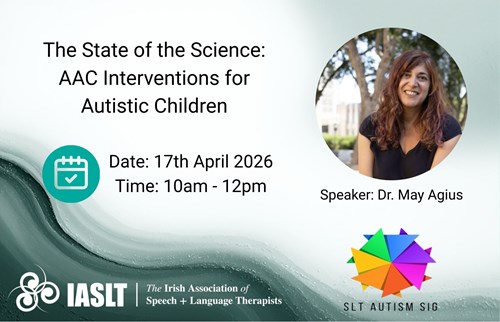
Dr. May Agius is a researcher and practitioner specialising in autism and Augmentative and Alternative Communication (AAC). She has extensive experience leading AAC services in education, training professionals and families, and contributing to international initiatives with the WHO, UNICEF, and UNESCO. Her work focuses on bridging research, technology, and inclusive practice to enhance participation and communication outcomes for autistic learners.
This session offers participants an opportunity to engage critically with the current evidence base while reflecting on its translation into real-world practice. It is designed to inform, challenge, and inspire professionals to apply the most up-to-date, person-centred approaches to AAC for autistic children.
Visit the CPD Events FAQ page HERE

If you have are having difficulty logging in or registering, please contact us at cpdadmin@iaslt.ie.
Sign in to your account to continue.