

My project aims to investigate the life experiences of people with RRMS who experience communication difficulties through conducting qualitative interviews with these people (either on Zoom or at the Trinity School of Linguistic, Speech and Communication Sciences in person if preferred) which will be transcribed and analysed thematically to draw common threads and identify strengths and limitations in the clinical management of communication difficulties, the environment, and communication of other people in their everyday life.
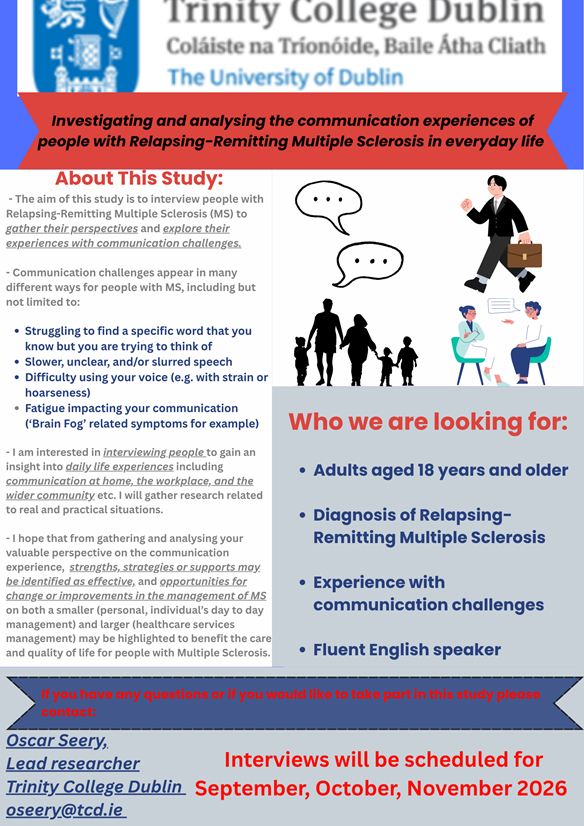
Participants are needed for a student research project as part of undergraduate Speech and Language Therapy studies in Trinity College Dublin CSLS. Participants must be aged 18 years or over, be diagnosed with Relapsing-Remitting MS, and present with communication difficulties associated with MS but not with any other condition. They must speak fluent English.
The aim of this study is to interview people with Relapsing-Remitting Multiple Sclerosis to gather their perspectives and explore their experiences with communication challenges. Communication challenges can appear in many different ways for people with Multiple Sclerosis, with scenarios including but not limited to:
I am interested in interviewing people who experience these communication challenges to gain an insight into how they impact on or influence their daily life experiences; communication at home, in the workplace and in the wider community etc. I will gather research that is related more to real and practical situations. I hope that from gathering and analysing your valuable perspective on the communication experience, that strengths, strategies or supports may be identified or noted as effective, and opportunities to make changes or improvements in the management of Multiple Sclerosis on both a smaller (personal, individual’s day to day management) and larger (healthcare services management) may be highlighted for future development to benefit the care and quality of life for people with Multiple Sclerosis.

If you have are having difficulty logging in or registering, please contact us at cpdadmin@iaslt.ie.
Sign in to your account to continue.